Ffestiniog Railway
The Ffestiniog Railway was originally built to be worked by gravity, with horses used to haul the empty slate wagons uphill from Porthmadog to Blaenau Ffestiniog. By the late 1850s it was clear that the line was reaching its carrying capacity, while the production from the slate quarries was continuing to expand. In order to increase capacity, in 1860 the board began investigating the use of narrow guage steam locomotives for the railway.
In 1862, the railway advertised in The Locomotive magazine asking for manufacturers to bid to supply an 0-6-0 T locomotive to the railway. Although they received 29 expressions of interest, none were accepted. Charles Menzies Holland was acting as locomotive designer for the Ffestiniog Railway and he approached George England, who lived near him in London. George England agreed to bid for the contract and in February 1863 he proposed building three 0-4-0 TT locomotives primarily to his own design. This bid was accepted and construction began. England’s design was for a small 0-4-0 locomotive with side tanks and tender. The locomotives had a low centre of gravity and were extremely small to fit within the restricted loading gauge of the railway.
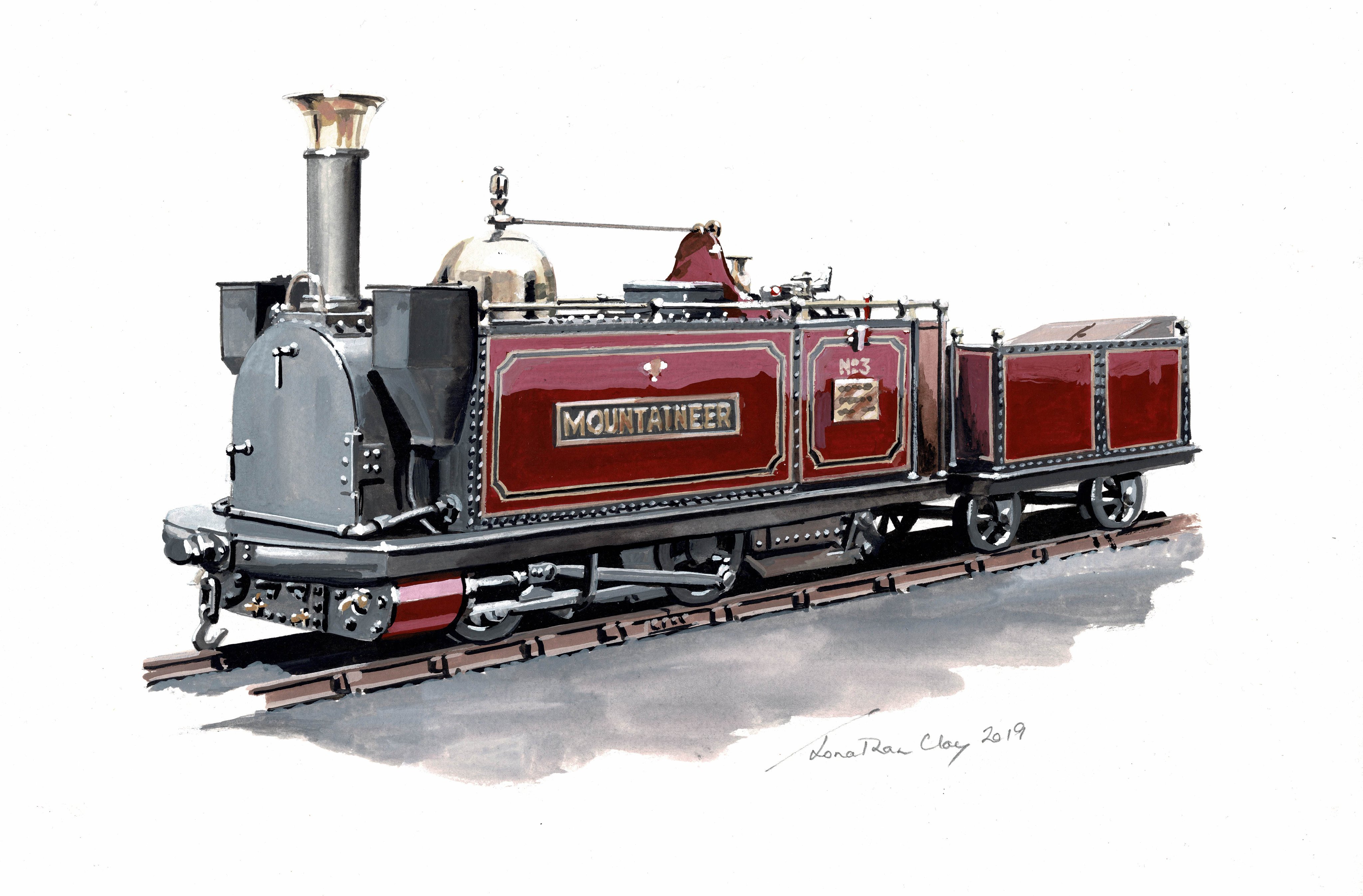
The first pair of locomotives, Mountaineer and The Princess, arrived in July 1863. They were delivered without steam domes, despite the objection of George England. As a result, they suffered badly from priming. Domes were hastily fitted in Wales before the locomotives could be run in service at Boston Lodge. The first formal steam-hauled train on the Ffestiniog Railway ran on 23rd October 1863.
The second pair, The Prince and Palmerston, arrived in 1864. These were to the same basic design as the first two locomotives, but were delivered with domes already fitted. The introduction of the initial locomotives was a great success, allowing the railway to handle the increasing slate traffic and its first formal passenger trains.

The Original George England
Mountaineer was one of the first four Ffestiniog Railway locomotives built by George England & Co. at Hatcham Iron Works London. It was a side tank locomotive with an open footplate.
Mountaineer Reborn
Using original drawings and casting patterns, supplied by the Ffestiniog Railway, our mission is to recreate Mountaineer as near to the original specification as modern engineering standards will allow. Blending traditional and modern production techniques, Mountaineer will live again!

FAQ
Can I be part of the project?
Absolutely! We would love to welcome narrow gauge and railway engineering enthusiasts alike to be part of our adventure. You can contact Chairman David Wood to become an official ‘Mountaineer‘.
How far along is the rebuild?
If you’d like to know about the journey so far, take a look at our news page which shares regular updates on our latest fundraiders and progress.
How can I find out more?
Chairman David Wood is available to discuss any questions you may have about the project. If you’d like to discover the very latest progress or just want to get to know the ‘Chief Mountaineer’, he’d love to hear from you!
Become a Mountaineer
If you want to join us in reviving locomotive history the join the project today!
 1863 Mountaineer Locomotive Project